ADF-SERIALS
Australian & New Zealand Military Aircraft Serials & History
RAAF A35 Douglas Dolphin
A Brief History of the Douglas Dolphin in RAAF Service
by Paul McGuiness
The Dolphin was built by Douglas Aircraft in 1930 as the "Sinbad," a pure flying boat without wheels. The Sinbad was intended as a luxurious flying yacht for America’s many millionaires but the Great Depression prevented any sales. Undaunted by the lack of demand, Douglas improved the Sinbad in 1931 so that it was amphibious, and could land on water or land. The improved aircraft was named "Dolphin", however this did not represent the end of development, as many more improvements were made, including an increase in the length of over a foot and several changes were made to the empennage, engine nacelles and wings. Douglas managed to attract the interest of the United States Coast Guard who not only bought the Sinbad, but 12 Dolphins and the success of the Dolphin helped the Douglas Aircraft Co. survive the Great Depression.
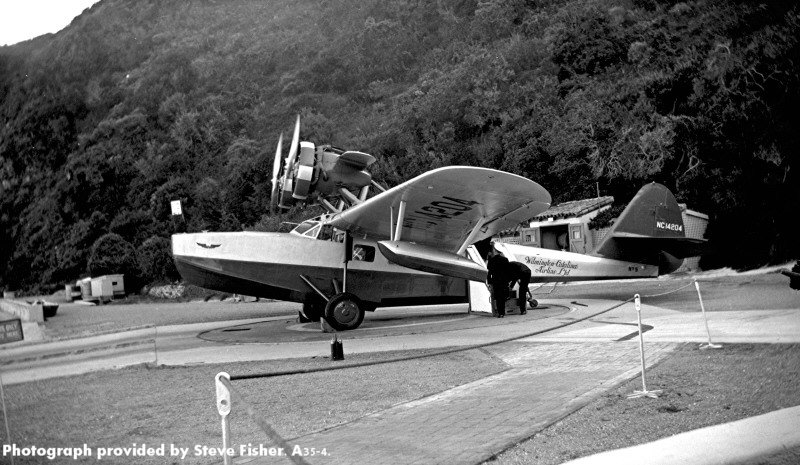
The first two production Dolphins were purchased by Wilmington-Catalina Airlines to fly passengers between Los Angeles and Santa Catalina Island, becoming the first successful Douglas airliners. Other Dolphin owners included William Boeing, the founder of the Boeing Company, and Philip K. Wrigley, the son of the founder of the William Wrigley Jr Company. William K. Vanderbilt bought two with custom interiors for use from the Vanderbilt yacht Alva as flying tenders. Standard Oil of New Jersey purchased two aircraft for exploration use.
Its outstanding success, both with the Coast Guard and private operators, attracted the attention of the US government with the result that further Defence contracts were awarded for the US Army and US Navy. The Army received 24 as transports, bearing the designations C-21 and C-26, later becoming observation amphibians (OA); while the Navy received 10 as RD transports. There were a total of 58 Dolphin aircraft built over the life of its production run between 1931 and 1934.
The RAAF operated a total of four Dolphins: NC42186 (A35-1) operated in New Guinea on oil survey work with civilian operators until it was donated to the RAAF in June 1940; NC12212(A35-2) was operated by the Wilmington-Catalina Airline Ltd in the USA until purchased by the Australian Government; NC982Y (A35-3) was operated by the Crosley Radio Company in the USA until purchased by the Australian Government; and, NC14204 (A35-4) was operated by the Wilmington-Catalina Airline Ltd in the USA until purchased by the Australian Government.
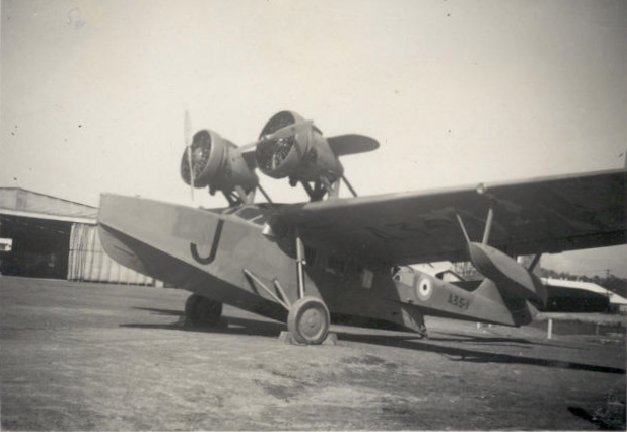
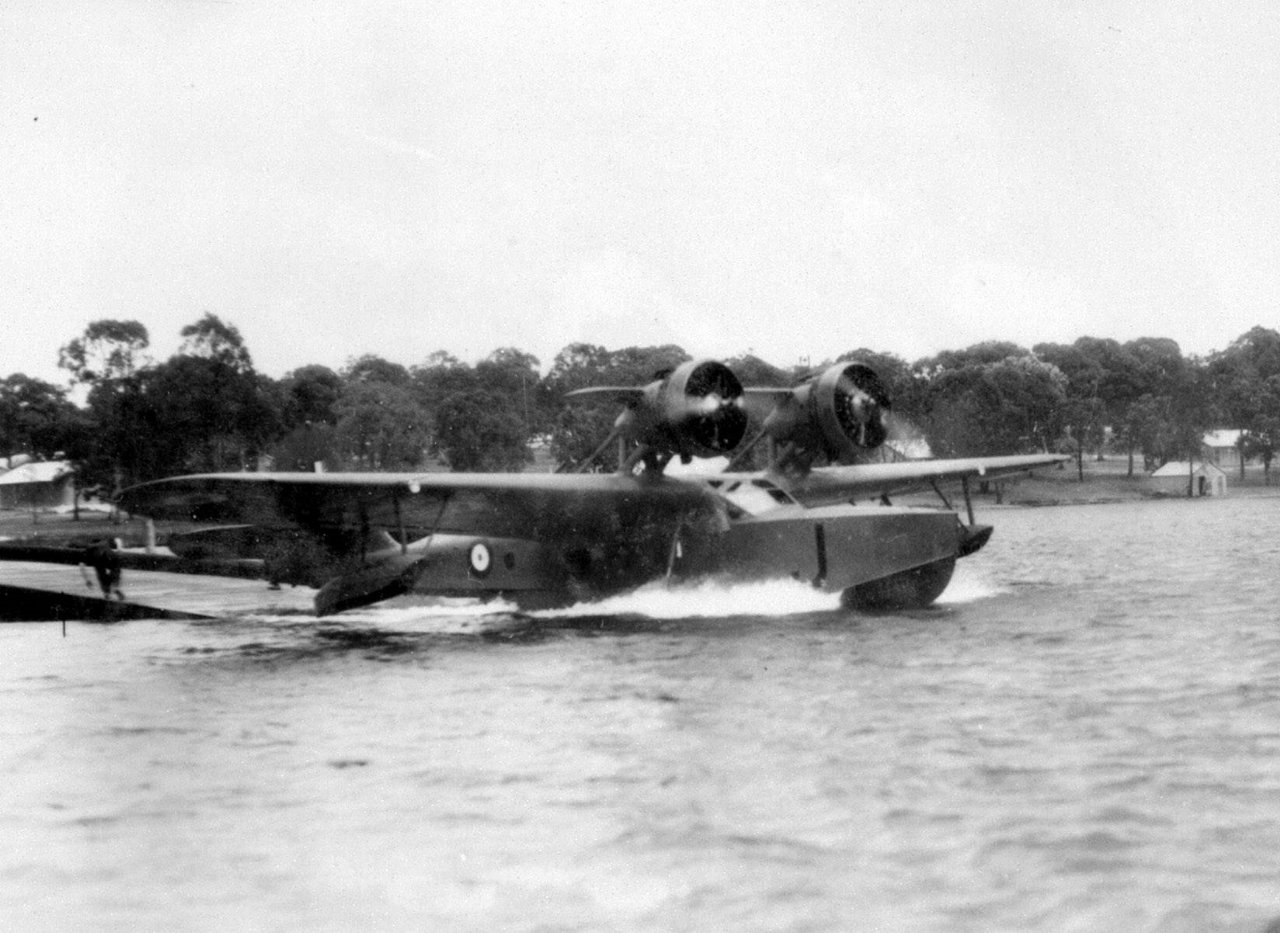
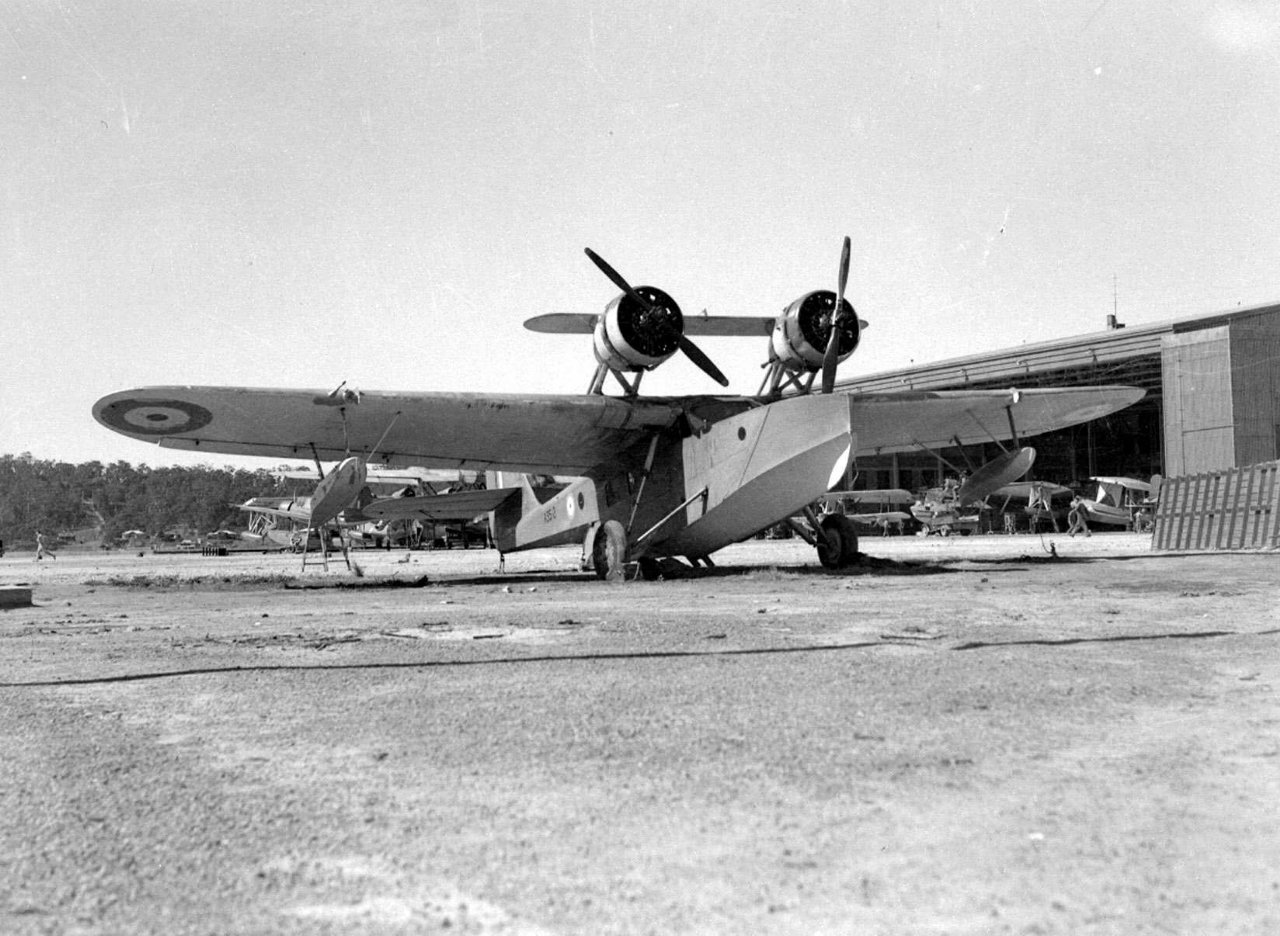
The Dolphin was only used as a stop–gap seaplane trainer and squadron hack at RAAF Base Rathmines until sufficient numbers of Catalinas were available. In service they proved difficult to maintain because of spares unavailability. Aircrew found them easy to fly and, given their ancestry, quite comfortable and spacious when compared to other seaplanes of the era. Apart from the spares availability issue ground crews found them easy to maintain. Three of the four Dolphins were converted to components during the war and the lone survivor was sold to a civilian operator after war’s end.
Aircraft Serial |
c/n |
Individual Aircraft History |
A35-1 |
1282 |
1934 Manufactured by Douglas Aircraft Company at their Clover Field factory in Santa Monica, California as a Dolphin Model 136 for Standard Oil Co New Jersey USA. Powered by two Pratt & Whitney 450hp Wasp Juniors. 1934 Registered as NC14286 to Standard Oil, New Jersey USA. 1934-38 Operated as an executive aircraft named ‘Essowing’. 16Oct38 Transferred to the newly formed Australasian Petroleum Company (APC) Pty Ltd, an associate company of Standard Oil. APC was founded as a joint venture between Vacuum oil Co, Anglo-Iranian Oil Co and Oil Search Ltd (USA). 1938 Prepared for shipment to Australia by Charles H. Babb Company, Glendale Air Terminal, California loaded onto the 5,293 ton Swedish Rederi Line ship M.V Eknaren. 02Jan39 Arrived at Newstead Wharf Port Brisbane. Trucked to Archerfield aerodrome for assembly and testing. 05Jan39 Departed Archerfield for Port Moresby, flown by pilot Fred E. Secor, and Chief Engineer J. R. Lund and photographer Morgan Reynolds. All were Americans with extensive experience in aerial survey. 08Jan39 Forced to land at the mouth of the Daintree River because of bad weather. Eventually reached Port Moresby and began a large scale exploration and aerial photographic mapping survey of Papua New Guinea in the search for oil deposits. 28Sep39 Sydney Custom’s ledger shows NC14286 arrived 0920hrs at Mascot Aerodrome, Sydney from Port Moresby via Cooktown. Captain F. E. Secor, operator Australasian Petroleum Co 27May40 The Minister for Air (Mr. J. V. Fairbairn) announced that a Dolphin seaplane had been presented to the Australian Government by Australasian Petroleum Co Pty Ltd. He said the Government greatly appreciated the spirit that prompted the company's actions. The aircraft would probably be allotted to the seaplane base at Rathmines for training. 17Jun40 Received by at RAAF Base Rathmines NSW and taken on charge as A35-1. Aircraft included some spares, specialist tools, manuals and a spare engine. Issued to No 9 Sqn at Rathmines and used for general training and other duties as specified. 18Jun40 WGCDR J.A.S Brown, O260 FLGOFF Ernest Victor Beaumont and O31233 FLGOFF Walter Frederick Stokes flew to Mascot in Seagull A2-18 at 0700 to ferry A35-1 back to Rathmines. A35-1 returned to Rathmines piloted by WGCDR J.A.S Brown and FLGOFF Beaumont. 05Dec40 WGCDR J.A.S. Brown RAF was conducting a routine flight to Newcastle when he noticed smoke on the horizon and decided to investigate. Smoke was coming from floating wreckage containing 13 survivors from the SS Nimben that had struck a mine dropped by the German raider HSK5 Pinguin along the NSW coastline. The crew of the Dolphin guided SS Bellembi to pick up the survivors. 06-8Dec40 Mine reconnaissance missions flown by WGCDR Brown O260691 PLTOFF George Moore Mason between Sydney Heads and Newcastle Heads. 14Feb41 Engine 2679 replaced by 3539. 05Jun41 Allocated to STF. 07Jun41 Received by STF. 09Aug41 Flown to Rose Bay, Sydney and return by O45 SQNLDR Dermott Anthony Connelly 03Sep41 Allocated to Rathmines Station Workshop for complete overhaul. 06Sep41 Issued to station workshop. 01Jun43 Unable to complete overhaul, insufficient spares. Recommended conversion. 15Jul43 Approved for conversion by HQ No 5 Maintenance Group. Components used to rebuild A35-3. |
A35-2 |
1002 |
1931 Manufactured by Douglas Aircraft Company at their Clover Field factory in Santa Monica, California as a Dolphin Model 1 for chewing gum company heir multi-millionaire Phillip K. Wrigley of California USA. Powered by two Wright 300hp J-5C Whirlwind engines. 1932 Registered as NC12212 to Wilmington Catalina Airline Ltd, Wilmington California. 1932-41 Operated the 26 miles airline service from Wilmington in the Los Angeles harbour area to Avalon on Catalina Island with two Dolphins and three other amphibians. The airline built its own airport on the island with a sloping ramp into the sea, a turntable to rotate the aircraft for departure down the ramp, and a passenger terminal building. 1935 Redesignated as a Dolphin Model 1 Special when modified to seat 10 passengers and re-engined with Pratt & Whitney Wasp SC1. Continued on the Catalina Island service until 1941. Apr41 Purchased by the Australian Government Trade Commissioner in New York and shipped to Australia. Order No O.I 893/41. 20May41 Prepared for shipment to Australia by Charles H. Babb Company, Glendale Air Terminal, California dispatched from Los Angeles. 25Aug41 Arrived in Sydney and taken to RAAF Richmond for assembly and testing. 20Sep41 Received by Seaplane Training Flight (STF) at RAAF Base Rathmines, NSW. 08Oct41 After landing at Bankstown airfield the aircraft ground looped causing moderate damage. Pilot O260764 FLGOFF Lionel Grenville Webber and crew were uninjured. 11Oct41 Received by STF Workshops for repairs. 12Jan42 Issued to HQ Rathmines. 12Feb42 Allocated to No 9 Fleet Co-Operation Squadron at RAAF Rathmines. 02Mar42 Received by 9 Sqn. Coded as “YQ-Z”. 27Jul42 While on a routine training mission both engines cut out at 3,000ft and an emergency landing as made at Fullerton Cove on the north arm of the Hunter River between Newcastle and Williamtown. Cause of the cut out was contaminated fuel. Aircraft switched to auxiliary tanks and flown back to Rathmines. 21Sep42 Forced landing at Rathmines caused damage to hull and tail unit. 13Oct42 Issued to No 2 Flying Boat Repair Depot at Rathmines (2FBRD) Workshops for repairs. 03Nov42 Allocated to 9Sqn but stored at 2FBRD. 12Apr43 Issued to No 3 Operational Training Unit (3OTU) at Rathmines. 23Jun43 Routine inspection found two badly corroded hull plates. 24Jun43 Allocated to and received by 2FBRD for hull repairs. 01Jul43 Received by 3OTU following hull repairs. 08Jul43 Allocated to 9 Sqn (now) at Bowen QLD. 20Jul43 Received by 9 Sqn. 15Nov43 Allocated to 2FBRD for overhaul. 12Dec43 Received by 2FBRD. 24Jan44 Overhaul suspended. Survey report stated corrosion and structural problems were beyond economical repair. Recommended conversion to components. 14Feb44 MSE gave approval for conversion. Components to be utilised for rebuilding A35-3. |
A35-3 |
1001 |
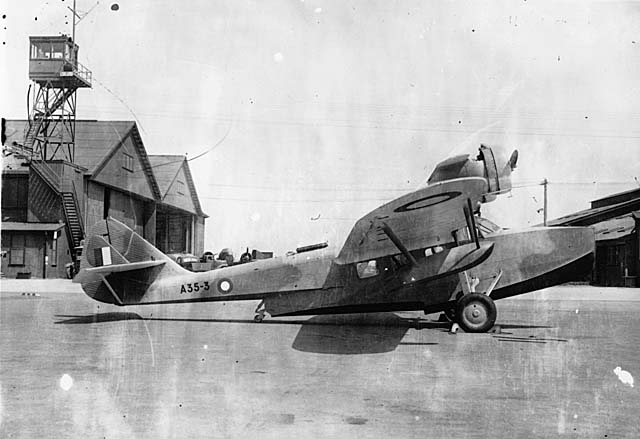
Jun31 Manufactured by Douglas Aircraft Company at their Clover Field factory in Santa Monica, California as a Dolphin Model 3 for US industrialist Powell Crosley Jr, specifying seating for 2 pilots and a deluxe air yacht cabin with seating for 4 passengers. Engines 300hp P&W R-985 Wasp Junior A. Jun31 Registered NC982Y Powell Crosley / Crosley Radio Company California, USA. Named "Lesgo" 29Jun31 CAA issued Approved Type Certificate to NC982Y as a Dolphin 3 01Nov31 Delivered to owner. Operated with wheel spats fitted to the main retractable undercarriage. Jun38 Major overhaul by Pratt & Whitney. Modified to Dolphin Model 1 Special. Jan41 NC982Y was included in a group of 5 Dolphins offered by US aircraft dealer Charles H. Babb Co, Grand Central Air Terminal, Glendale California to the Australian Government Trade Commissioner in New York for the sum of $25,000 each plus boxing and freight. Aircraft had a total of 1500 hours. Apr41 Purchased by the Australian Trade Commissioner in New York and shipped to Australia. 1941-42 Arrived in Melbourne, Australia at some date and was stored at No 1 Aircraft Depot (1AD) RAAF Base Laverton awaiting erection. 05Oct42 Issued to Technical Squadron at RAAF Base Point Cook VIC for assembly and testing. 09Nov42 Allocated to No 9 Fleet Cooperation Squadron at RAAF Base Rathmines. 21Nov42 Received by 9Sqn. 09Jan43 Allocated to HQ Rathmines. 11Jan43 Received by HQ. 13Jan43 Allocated to No 3 Operational Training Unit (3OTU) at RAAF Rathmines. 20Jan43 Received by 3OTU. 25Jan43 Issued to No 2 Flying Boat Repair Depot (2FBRD) at RAAF Rathmines. 25Jan43 Received by 2FBRD for repairs. 22Mar43 Allocated to and received by 3OTU. 1943-44 A35-3 rebuilt at Rathmines using parts from A35-1 and A35-2. It was a major rebuilding task which took eight months and was commended by Donald Douglas after WWII. Ex RAAF FSGT Harold Nathan Berrick wrote the following in the RAAF News November 1964: "I was the NCO (airframe) in charge of the rebuilding of A35-3 from the components of A35-1 and A35-2 a job which took some eight months to carry out. We used the hull of A35-3, which was almost complete rebuilt, the mainplane of A35-1 and undercarriage, hydraulic system and cockpit controls from A35-2. A new pair of floats were made and the reconditioned motors were from A35-1." Considerable modifications were necessary as the three aircraft were all different in their layout, cabin fitment, hydraulic systems, engines and tailplane assembly. 06Dec44 Last flight in RAAF Service. 13Dec44 Survey Report for the Commonwealth Disposals Commission (CDC) by WGCDR G.R. Thurston, CO of 3OTU Rathmines stated: P&W Wasp Juniors serviceable, aircraft condition is good, unserviceable brakes limit it to water operations only. Total hours flown in RAAF service 145:25 hours: "All previous history of the aircraft before RAAF acceptance is unknown. Airframe log books make no reference to previous hours flown. This aircraft being the only one of its type in RAAF it is most uneconomical from both the service and maintenance point of view because replacement parts are impossible to procure." Jan45. Listed for sale on the 1st CDC Tender with a closing date of 20Feb45. 29Mar45 Sold by CDC for £550 to a Mr M. Whittle of Newcastle, NSW. 01May45 The Managing Director of Newcastle Safety Airways (Mr Stuart F Doyle) told DCA they planned to use the Dolphin on a scheduled daily service from Sydney to Newcastle. 03May45 Aircraft collected from 3OTU by purchaser. Ferried to Mascot airport Sydney. 04May45 Allocated registration VH-AGE. 24May45 DCA decided that the Dolphin would not be granted a passenger operation CofA due to its unsatisfactory single engine performance. DCA suggests that flight performance tests may allow a reduced All up Weight to be applied to a CofA for cargo operations. Jun45 Newcastle Safety Airways cancel their arrangements with Mr. M. Whittle. 13Jun45 Aircraft ferried to Essendon Airport, Melbourne. 06Jul45 M. Whittle confirmed with DCA that his charter arrangements with Newcastle Safety Airways have been cancelled. Furthermore, he petitioned DCA to assist him to force CDC to repossess the aircraft and refund all his costs and threatened legal action unless his demands were met because the aircraft had become a liability and he considers he was exploited. An internal DCA review of Whittle's complaint was sympathetic. DCA wrote to CDC suggesting that they take the Dolphin back and have it scrapped. Minutes of a CDC meeting held on 10.9.45 include "It was decided to defer actions pending the re-sale of the Douglas Dolphin by Mr. Whittle." 04Aug45 Sidney D. Marshall of Marshall Airways, Mascot Airport, Sydney advised DCA's Sydney office that he wished to purchase the Dolphin VH-AGE. He requested permission for a test flight and required a petrol ration for the test flights. 05Aug45 DCA Sydney refused permission for a fuel ration as it was highly improbable that the aircraft would be granted a Certificate of Airworthiness. 08Aug45 Despite the DCA rebuff Mr Marshall bought the aircraft and notified DCA of this fact and requested permission to conduct test flight following an overhaul. Sep45 DCA were still very concerned about the aircraft's poor performance on one engine. However there was consideration of Sid Marshall's wartime ambulance flying and his maintenance of RAAF aircraft with the minimum of resources. Decision taken to reply to Marshall that a CofA would be considered for freight and private flying only, subject to satisfactory flight performance tests carrying varying loads of freight. DCA nominated the dates of 3rd & 4th October 1945 for flight tests of the Dolphin at Sydney. 16Oct45 DCA decided not to grant a CofA to Mr Marshall. 14May46 A report in the Sydney Morning Herald stated that a seaplane flown by Mr Marshall had laned in Botany Bay, took-off and landed again on the Cooks River. 1946 Aircraft withdrawn from service. 17Jul49 Sydney Sunday Herald newspaper report: Australia's only Dolphin amphibian is parked at Mascot outside the Marshall Airways hangar. It is owned by a Sydney syndicate and operated by Marshall Airways but has not moved from its present position in many months. Mr. Sid Marshall said "It was hoped to run an aerial ferry service with her after she left the R.A.A.F.," he said. "We also thought it might be possible to run a charter service to places that needed an amphibious aircraft. But somehow these plans did not materialise." "The old lady has a splendid flying record," he remarked. "She can land at 50 miles an hour and has no vices when operating on land or water." An agent for a proposed trawling expedition said recently that his firm was considering buying the plane to spot shoals of fish out at sea. The plane could be equipped with radio, he said, so that the pilot could guide the trawlers to the best fishing grounds. It could also act as a weather ship to warn the fishing boats of the approach of bad weather. 1949 The Dolphin was seriously considered for a new seaplane venture in New Zealand by W. Hewett and H.J. Cartres. They wanted to establish an amphibian service between Invercargill and Stewart Island and also to Fiordland. The initial announcement stated they would use a Douglas Dolphin which was in Australia but this operation never commenced. 1950 The last Australian Dolphin was abandoned on the fringe of Mascot Airport still wearing its RAAF camouflage. It is assumed the aircraft was simply scrapped at some time. |
A35-4 |
1279 |
1934 Manufactured by Douglas Aircraft Company at their Clover Field factory in Santa Monica, California for chewing gum company heir multi-millionaire Phillip K. Wrigley and part owner of Santa Catalina Resort Island off Los Angeles, who specified 450hp Wasp SC1 engines. Referred to at the Douglas factory as the Wrigley Number Five. 1934 Registered NC14204 to Phillip K. Wrigley, California USA. 1934-40 Modified to Dolphin Model 114 and operated by Wilmington-Catalina Airline Ltd on the 26 miles airline service from Wilmington in the Los Angeles harbour area to Avalon on Catalina Island. The airline built its own airport on the island with a sloping ramp into the sea, a turntable to rotate the aircraft for departure down the ramp, and a passenger terminal building. 1940 Change of ownership to Catalina Air Transport, Long Beach California. In use with CAT from 1940 Dec 1941. 1941-43 History unknown. 1943 Arrived in Melbourne at some unknown date and stored at No 1 Aircraft Depot (1AD) RAAF Base Laverton awaiting erection. 08Apr43 Issued to Technical Squadron of No 1 Service Flying Training School at RAAF Base Point Cook VIC for assembly and testing. 12May43 Temporary allocation to No 3 Operational Training Unit (3OTU) at RAAF Rathmines. 22May43 Received by 3OTU. 18Jun43 Allocated to No 4 Communications Unit (4CU) at Archerfield airport Brisbane. 08Jul43 Received by 4CU 28Jul43 Allocated to No 9 Fleet Cooperation Squadron at Bowen QLD. 29Jul43 Departed Archerfield for Rose Bay, Sydney. Crew of SQNLDR Wood and FLGOFF Forbes with passengers AIRCDR J.H. Summers and FTTLT Ebeling. After disembarking passengers the aircraft took-off for flight to RAAF Rathmines. Immediately after take-off a hydraulic failure caused the undercarriage to drop and could not be retracted. An emergency landing was made on Rose Bay and the aircraft overturned when it touched down causing extensive damage. 30Jul43 Aircraft salvaged by members of No 1 Transport & Movements Office Sydney. 02Aug43 Allocated to No 2 Flying Boat Repair Depot (2SBRD) at RAAF Rathmines for inspection. 2FBRD to arrange transport from Rose Bay to Rathmines. 03Aug43 Allocation to 9 Sqn cancelled. 08Aug44 AMSE approved conversion to components. 1944 Aircraft converted to components at 2FBRD. |
The Authors of this page are Paul McGuiness ,Darren Crick, Steve Mackenzie and Brendan Cowan
Sources: RAAF Website, RAAF Douglas Dolphin Status cards from National Archives, The Douglas Dolphin in RAAF Service - Geoff Goodall & David Eyre (Aviation Heritage Vol 25 No1),
Emails: John Andrade, Terrence Geary, Bob Livingstone., ADF-Serials Messageboard discussion , Nelson Little, Brendan Cowan,
Version 1.1a dated 08 September 2015
It is our policy to only show historical events, no current operational information will be displayed on this website.
"The ADF-Serials team give permission to use the content of this page, excluding images, providing that it contains an acknowledgement to the adf-serials team and any other listed sources."
